



Calcium Channel
Ca2+ channels; Ca channels
Calcium channel is an ion channel which displays selective permeability to calcium ions. It is sometimes synonymous as voltage-dependent calcium channel, although there are also ligand-gated calcium channels. Voltage-gated calcium (CaV) channels catalyse rapid, highly selective influx of Ca2+ into cells despite a 70-fold higher extracellular concentration of Na+. Some calcium channel blockers have the added benefit of slowing your heart rate, which can further reduce blood pressure, relieve chest pain (angina) and control an irregular heartbeat.
Calcium Channel Isoform Specific Products
All Product Categories
-
Calcium Channel Inhibitors
(595)
View all products
-
Calcium Channel Agonists
(35)
View all products
-
Calcium Channel Antagonists
(209)
View all products
-
Calcium Channel Activators
(88)
View all products
-
Calcium Channel Modulators
(45)
View all products
-
Calcium Channel Chemical
(1)
View all products
-
Calcium Channel Inducers
(12)
View all products
-
Calcium Channel Controls
(10)
View all products
-
Calcium Channel Ligands
(7)
View all products
-
Calcium Channel Related Products (1239)
Related Products (1239)

-
Antibodies (29)
-
Related Compound Screening Libraries (1)
-
Calcium Channel Isoform Comparison
-
Barnidipine hydrochloride (Standard)
 0 ImagesCat. No.: HY-107322RCAS No.: 104757-53-1Synonyms: Mepirodipine hydrochloride (Standard); YM-09730-5 (Standard)Barnidipine hydrochloride (Standard) (Mepirodipine hydrochloride (Standard)) is the analytical standard of Barnidipine (hydrochloride) (HY-107322). This product is intended for research and analytical applications. Barnidipine (Mepirodipine) hydrochloride is an L-type calcium antagonist (CaA) with high affinity for [3H] initrendipine binding sites (Ki = 0.21 nmol/L, has selective action against CaA receptors. Barnidipine hydrochloride is an orally active antihypertensive agent that can reduce the level of platelet-derived growth factor B-chain mRNA and peripheral vascular resistance.
-
PD-151307
 0 ImagesCat. No.: HY-118974CAS No.: 225925-12-2PD-151307 is an N-type calcium channel antagonist with significant inhibitory effects in IMR-32 human neuroblastoma cells, exhibiting an IC50 of 0.32 µM. PD-151307 can be used in research related to cancer therapy, anticonvulsants, and neuropathic pain.
-
Nilvadipine (Standard)
 0 ImagesSynonyms: FK235 (Standard); FR34235 (Standard)Nilvadipine (Standard) is the analytical standard of Nilvadipine. This product is intended for research and analytical applications. Nilvadipine is a potent calcium channel antagonist, and the IC50 value is around 0.1 nM.
-
8-Br-7-CH-cADPR
 0 ImagesCat. No.: HY-134269CAS No.: 189876-06-0Synonyms: 7-Deaza-8-bromo-cADPR; 7-Deaza-8-bromo-cyclic ADP ribose8-Br-7-CH-cADPR (7-Deaza-8-bromo-cADPR) is a potent cADPR antagonist. 8-Br-7-CH-cADPR shows partial inhibition of calcium elevation caused by sTIR dimerization. 8-Br-7-CH-cADPR significantly decreases Paclitaxel (HY-B0015)-induced axon degeneration.
-
Praeruptorin E (Standard)
 0 ImagesCat. No.: HY-N6066RCAS No.: 78478-28-1Praeruptorin E (Standard) is the analytical standard of Praeruptorin E. This product is intended for research and analytical applications. Praeruptorin E is a main bioactive constituent of Peucedanum praeruptorum (also known as Bai-Hua Qian Hu). Praeruptorin C is a calcium antagonist with pD2′ value of 5.2.
-
NP-252
 0 ImagesCat. No.: HY-19053CAS No.: 132031-81-3NP-252 is a calcium channel antagonist with an 20% effective dose (ED20) of 2.55 mg/kg in spontaneously hypertensive rats.
-
Dopropidil hydrochloride
 0 ImagesCat. No.: HY-U00151ACAS No.: 117241-47-1Dopropidil hydrochloride is a novel anti-anginal calcium ion modulating agent, possessing intracellular calcium antagonist activity and anti-ischemic effects in several predictive animal models.
-
Ginsenoside Ro (Standard)
 0 ImagesCat. No.: HY-N0607RCAS No.: 34367-04-9Synonyms: Polysciasaponin P3 (Standard); Chikusetsusaponin 5 (Standard); Chikusetsusaponin V (Standard)Ginsenoside Ro (Standard) is the analytical standard of Ginsenoside Ro. This product is intended for research and analytical applications. Ginsenoside Ro (Polysciasaponin P3; Chikusetsusaponin 5; Chikusetsusaponin V) exhibits a Ca2+-antagonistic antiplatelet effect with an IC50 of 155 μM. Ginsenoside Ro reduces the production of TXA2 more than it reduces the activities of COX-1 and TXAS.
-
SR33805 analog
 0 ImagesCat. No.: HY-121701CAS No.: 121346-32-5SR 33805 (analog) is an orally active Ca2+ channel blocker that selectively inhibits the proliferation of smooth muscle cells. SR 33805 (analog) reduces calcium uptake by blocking calcium channels, thereby inhibiting smooth muscle cell proliferation induced by serum, platelet-derived growth factor, and basic fibroblast growth factor. SR 33805 (analog) significantly reduces intimal thickening following endothelial injury in rabbits. SR 33805 (analog) shows promise for cardiovascular disease research, such as in early atherosclerosis.
-
Nifedipine-13C8
 0 ImagesCat. No.: HY-B0284S2CAS No.: 1173023-46-5Synonyms: BAY-a-1040-13C8Nifedipine-13C8 is a deuterated labeled Nifedipine. Nifedipine (BAY-a-1040) is a potent calcium channel blocker and agent of choice for cardiac insufficiencies.
-
(R)-Azelnidipine
 0 ImagesCat. No.: HY-165634CAS No.: 722455-08-5(R)-Azelnidipine is a highly lipophilic Calcium Channel antagonist with high affinity for vascular walls and antihypertensive activity. (R)-Azelnidipine shows potential for use in cardiovascular disease research.
-
NSC156529
 0 ImagesCat. No.: HY-122201CAS No.: 41134-88-7NSC156529 is a potent T-type calcium-channel antagonist. NSC156529 shows inhibits on Cav3.1 and Cav3.2 and o Cav3.3 without effect. NSC156529 has the potential for the research of neuropsychic and genital system diseases.
-
Verapamil-d3
 0 ImagesCat. No.: HY-14275SCAS No.: 152561-91-6Synonyms: (±)-Verapamil-d3; CP-16533-1-d3Verapamil-d3 ((±)-Verapamil-d3) is deuterium labeled Verapamil. Verapamil ((±)-Verapamil) is a calcium channel blocker and a potent and orally active first-generation P-glycoprotein (P-gp) inhibitor. Verapamil also inhibits CYP3A4. Verapamil has the potential for high blood pressure, heart arrhythmias and angina research.
-
Diltiazem-d6 hydrochloride
 0 ImagesCat. No.: HY-14656S2CAS No.: 1309283-34-8Synonyms: CRD-401-d6 hydrochlorideDiltiazem-d6 (hydrochloride) (CRD-401-d6 (hydrochloride)) is deuterium labeled Diltiazem (hydrochloride). Diltiazem hydrochloride is a Ca2+ influx inhibitor (slow channel blocker or calcium antagonist).
-
SB-237376 free base
 0 ImagesCat. No.: HY-108163CAS No.: 179258-59-4SB-237376 (free base) is a potassium and calcium channel blocker. SB-237376 (free base) can inhibit the rapidly activating delayed rectifier potassium current I(Kr) (IC50 is 0.42 μM), and at high concentrations, it blocks the L-type calcium current I(Ca,L). In the rabbit ventricular model, SB-237376 (free base) can induce early afterdepolarizations (EADs) at a concentration of 3 µM. Compared to other IKr inhibitors such as dl-sotalol, SB-237376 has a lower proarrhythmic risk. SB-237376 (free base) holds potential for research in the field of arrhythmia-related diseases.
-
Terflavoxate
 0 ImagesCat. No.: HY-106415CAS No.: 86433-40-1Terflavoxate is a flavone derivative with spasmolytic properties. Terflavoxate has Ca2+-antagonistic effect is mainly responsible for Terflavoxate smooth muscle relaxant properties. Terflavoxate has the potential for overactive detrusor research.
-
Tiapamil hydrochloride
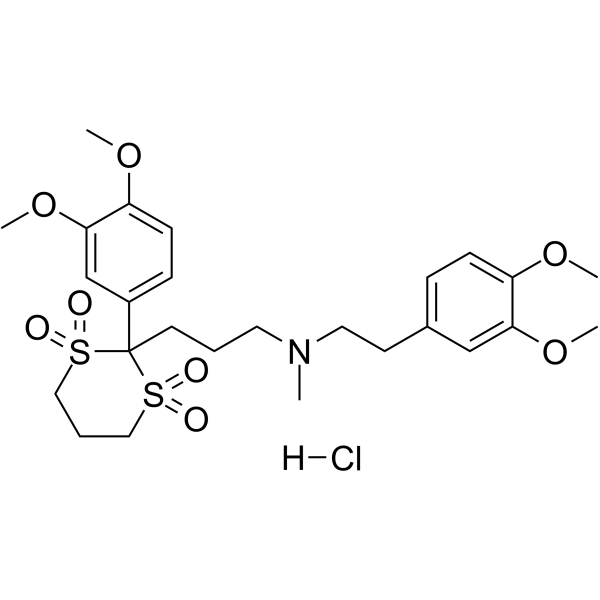 0 ImagesCat. No.: HY-101674CAS No.: 57010-32-9Synonyms: Ro 11-1781Tiapamil hydrochloride is a calcium channel blocker.
-
Iganidipine
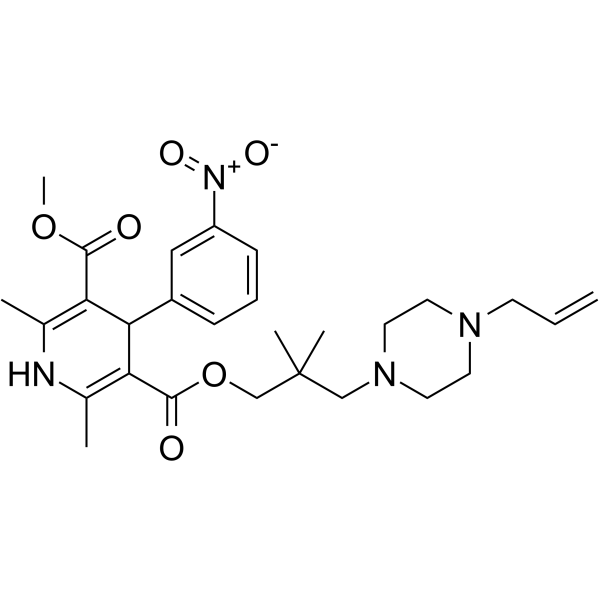 0 ImagesCat. No.: HY-101685CAS No.: 119687-33-1Iganidipine is a Ca2+ antagonist.
-
SM-6586
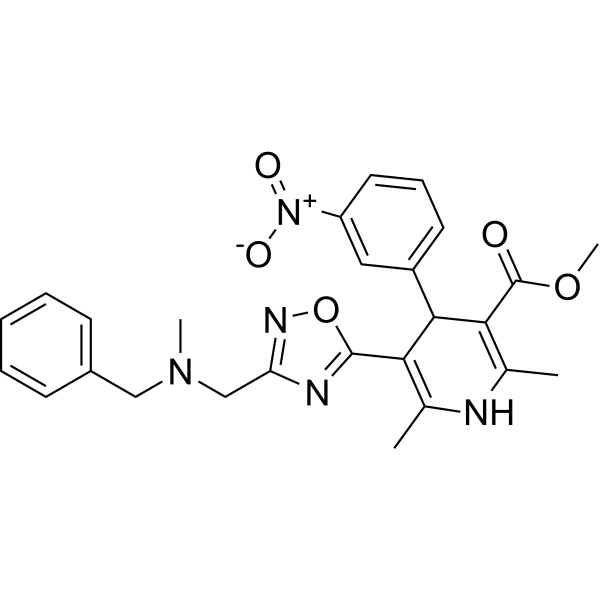 0 ImagesCat. No.: HY-19062CAS No.: 103898-38-0SM-6586 is a calcium channel antagonist and inhibitor of Na+/H+ and Na+/Ca2+ exchange transport, potentially for the treatment of cerebrovasular diseases and hypertension.
-
TDN345
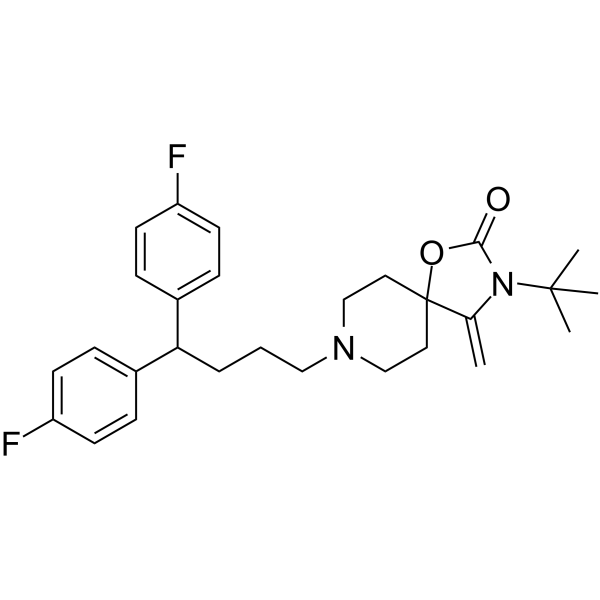 0 ImagesCat. No.: HY-101669CAS No.: 134069-68-4TDN345 is a Ca2+ antagonist, used for the treatment of vascular and senile dementia including Alzheimer's disease.




